File:In Memory of George E Brown, an Earth Science Visionary.jpeg
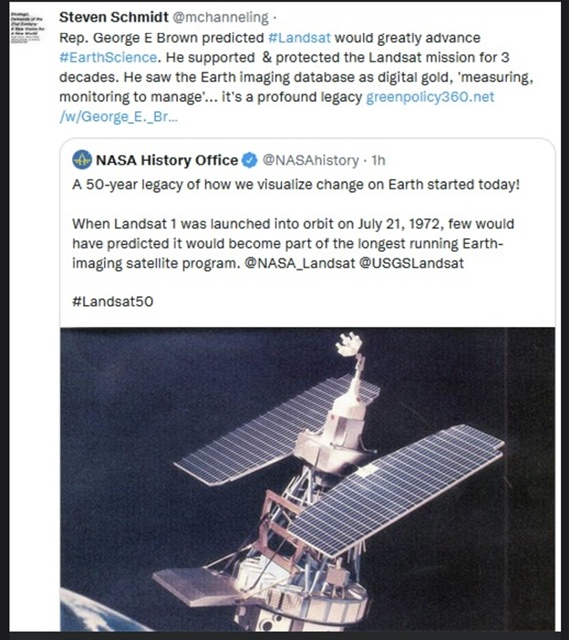
Original file (569 × 640 pixels, file size: 107 KB, MIME type: image/jpeg)
George E Brown
George's vision changed the ways we see our Planet Earth...

🌎
"George E. Brown, Congressman, Engineer, Trained Physicist
- Space, Science, Environment Visionary for Three Decades
As a high school student, I met George Brown in the mid-1960s and we began to work, purposefully and closely, to make environmental protection a political reality.
George Brown changed the direction of my life and was integral to the founding of Earth Day in 1970 as he helped to set in motion my lifetime of environmental activism. George was looking forward to the 21st century, and especially to the challenges of environmental and earth science programs that he led in Congress for decades, until suddenly he passed away in 1999.
George was an amazing man, a visionary who was a mover in the U.S. Congress from the 1960s through the 1990s. We began our friendship and work together on a political journey in the mid-60s and I quickly began to feel that I was the luckiest kid around. Who else begins debating nuclear weapons, war and peace, and the need for environmental "earth observing satellite missions" with a Congressman at such an age? Let me dedicate this GreenPolicy360 page to Representative George E. Brown as both a biography and memorial. George will always be an influencer for me and, as you will see in reading about George E. Brown at GreenPolicy360, how George's work and legacy is a key to understanding my generation...
Even today, I can see George holding up the first of its type climate science report in the mid-1970s and then drafting the first National Climate Act -- https://greenpolicy360.net/w/File:US_Public_Law_95-367.png
I can see back to the beginning of an Earth Observation "Inventory" he envisioned when he was proposing and shepherding a new Landsat program into existence. I remember years of learning, sharing and work alongside a congressman setting in motion and advancing decades of U.S. Earth science research programs. George E. Brown was a special person who brought a physics and engineering background to Congress. George saw what others didn't really understand. Your GreenPolicy360 siterunner immediately began to realize the future to come when our East LA Representative showed me documents and spoke of the Mission Statement of NASA. -- “To understand and protect our home planet..."

George E. Brown and the National Space Society
GreenPolicy360 Supports NASA's Measure-to-Manage Message

Earth Observing System
From the 1970s on... Decades of Earth Science/Climate Science Data Accessible for Planet Citizen Action

Measure to Manage
Permalink - http://bit.ly/2DZNTOA
GreenPolicy360 strongly supports good science. We look to baselines and trendlines, sets of data, the intelligence compiled and made available over time. 'Shifting baselines', as they are sometimes called, serve as a basis for smart and effective decision-making.
Monitoring the dynamics of change over time should be a guide for all of us. Whether in assessing real world challenges -- the CO2 emissions in the Earth's atmosphere or responding to a virus outbreak or global pandemic -- facts and measuring are critical in providing knowledge to know what decisions can best be made ...
The Critical Importance of Science & Facts
STEM areas of study - Science, Technology, Engineering, & Math, including Computer Science
🌎
"We are the first generation monitoring atmospheric science/earth science data changes over time.
Think about it -- the critical science data, baselines and trendlines, are just now coming into view."
- -- Steve Schmidt, GreenPolicy360 Founder/Siterunner
Establishing an Era of Earth Science Measuring & Monitoring
- Generational Vision, Looking Back to the Beginnings of the NASA and First Decades of US Earth Science, Digital Imaging Missions
Steven J. Schmidt: Remembering Congressman George E. Brown, instrumental in setting in motion the first era of earth science and atmospheric research from space. As the 'big science' advocate, member and chairman of the U.S. House Committee on Science, Space & Technology for three decades, Representative Brown's legacy is unparalleled.
As a trained engineer, George greatly valued the importance of facts, data, science and knowledge as a guide to decision-making and policy that looked to the future and environmental protection and security. Congressman Brown authored the first National Climate Act in 1978 and for years led the creation of scientific programs to gather critically important data.
For some forty years George Brown led science, atmospheric science, earth science, ocean science, educational initiatives, first gen, non-military government research & development, environment and technology initiatives, setting in place a strong foundation on which we have continued to build and advance shared goals since his passing in 1999.

George E. Brown, 1960s - 1990s
Representative from California, member/leader and a visionary chair of the Science, Space & Technology Committee
U.S. House of Representatives Committee on Science, Space and Technology
Established in 1958, the first committee since 1892 to be established for an entirely new area of jurisdiction
The Committee’s initial jurisdiction included exploration and control of outer space, astronautical research and development, scientific research and development, science scholarships, and legislation relating to scientific agencies. The scientific agencies under the Committee initially included the National Bureau of Standards (now the National Institute of Standards and Technology), NASA, the National Aeronautics and Space Council, and the National Science Foundation.
In 1974, the Committee’s name was changed to the "Committee on Science and Technology." At that time, the Committee’s jurisdiction was expanded to include legislation related to energy, the environment, the atmosphere, civil aviation research and development, and the National Weather Service. The Committee on Science and Technology was also given a "special oversight" function providing for exclusive responsibility among all Congressional Standing Committees to review and study, on a continuing basis, all laws, programs and government activities involving Federal non-military research and development.
Today the Committee has jurisdiction over much of the non-defense Federal research and development (R&D) portfolio. The Committee has exclusive jurisdiction over the National Aeronautics and Space Administration (NASA), National Science Foundation (NSF), National Institute of Standards and Technology (NIST), and the White House Office of Science and Technology Policy (OSTP). The Committee also has authority over R&D activities at the Department of Energy (DOE), Environmental Protection Agency (EPA), Department of Transportation (DOT), Federal Aviation Administration (FAA), National Oceanic and Atmospheric Administration (NOAA), National Weather Service (NWS), and the Department of Homeland Security (DHS).

SJS: In 1968//69 my East Los Angeles Congressional Representative spoke of the Mission Statement of NASA. This was an unprecedented time, a time when 'Earthrise', our blue-green planet as seen in space, first came into view. It was time -- “To understand and protect our home planet"
George E. Brown, 1995:
"I am struck, by how often I have pleaded with the scientific community to pay attention to the changes taking place in the world and the need to become more-closely linked with social goals and needs."
"I think that Congress and the nation can and does expect more from the research community than we see currently. At the very least we expect you to exercise a modicum of common sense. And common sense dictates that we make good on our promises of societal benefit, where those benefits are no longer the more obvious ones of national military security. Common sense dictates that we envision a new definition of security...based on a healthy, growing and sustainable economy; an improved global environment; and, most important, a just and equitable society, both in our own country and then in an increasingly interdependent global community."
Acting on Climate Change
Climate Action Plans @GreenPolicy360
GrnPolicy360: Climate Plans Enforcement Initiative
Methods to Enforce Climate Plan Pledges
Pressuring Nations to Step Up, Cooperate, and Act Now
Committee on Earth Observation Satellites (launching in 2023)
Environmental Laws, Regs, Rules... Lawsuits & Legal Actions
Glasgow (2021) & Paris (2015) Summits: Int'l Climate Plan Pledges & Promises (INDCs-NDCs)
🌎
Measuring, Monitoring, Preserving & Protecting
Planet Citizens, Planet Scientists
- https://www.greenpolicy360.net/w/Environmental_protection
- https://www.greenpolicy360.net/w/Category:Environmental_Protection
🌎

New Definitions of National Security
A Project of GreenPolicy360 and Strategic Demands




🌎
We are the first generation monitoring atmospheric science/earth science data changes over time.
- Think about the need for critical science data, baselines and trendlines that are just now coming into view. This is what we knew in the 1970s and 80s had to set in motion with Rep. George Brown and Space, Earth Science & Technology government resources and funding. Policy makers and the public needed Earth Science to provide the data for decisions, so we went to work, out in front, with a vision of doing what needed to be done. -- SJS/GreenPolicy360 Siterunner


File history
Click on a date/time to view the file as it appeared at that time.
| Date/Time | Thumbnail | Dimensions | User | Comment | |
|---|---|---|---|---|---|
| current | 15:10, 24 July 2025 | | 569 × 640 (107 KB) | Siterunner (talk | contribs) |
You cannot overwrite this file.
File usage
The following 2 pages use this file:
