File:George in Memory, a Man of Science and Humanity.jpg
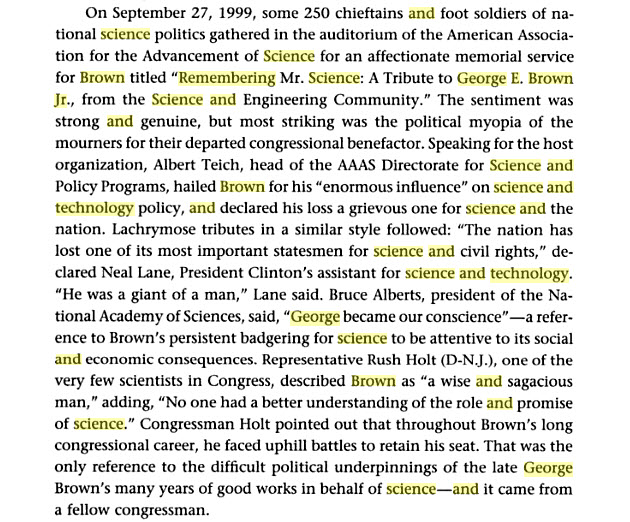
George_in_Memory,_a_Man_of_Science_and_Humanity.jpg (630 × 522 pixels, file size: 128 KB, MIME type: image/jpeg)
American Association for the Advancement of Science
Advancing Science, Facts, Technology and Data to Make the Case for Environmental Protection
- 1960s/70s, Beginnings of Planet Citizen Eco-Action, Big Science, and a New Vision
In Memory of Congressman George Brown
- Visionary Leadership, Historic Environmental Achievements
- Creating a Foundation for Today's National & Global 'Green' Movement

Steve Schmidt GreenPolicy360 Siterunner: George E. Brown became known as Mr. Science in Congress and for thirty+ years, I saw my friend George as a patriot who became a Planet Citizen for the ages
"My friend George"
As a high school student, I met George Brown in the mid-1960s and we began to work, purposefully and closely, to make environmental protection a political reality.
My first meeting with George Brown was to talk about debating nuclear weapons proliferation. It turned to cleaning up the air, "the Smog" in Los Angeles. The get together changed the direction of my life. I tell my story, as a teenager in East LA, riding a bike to meet George who had been recently elected to Congress. We quickly became friends but I didn't realize until years later that the road I chose to take soon after would lead to the founding of Earth Day in 1970 and would go on and on for decades. I've even come to believe, as time went by, that every day is an Earth day and Earth Day Is Every Day. The work came to be a mission and it was, in its way, about taking Earth science to the nation and world.
Rep. Brown was not known by many back then, or even today, but I saw George as a 'man at work', an engineer who worked to 'get the job done'. He was, in my mind, like my German father, an engineer and builder. He was also like "Engineer Bill", the TV character whose famous line was 'on the green light you go'. And so it went. George joined the oversight committee responsible for science/technology/environment/space. Things began to change. Often moving quietly out of the spotlights, George was a mover-shaker with far reaching impacts.
Over the years George taught me in his work and he shared with the world in his decades of U.S. Congressional action what it is to envision what could be and needs to be accomplished, and how to go forward and do what was needed to be done. I think he, as a mentor, taught me how to 'turn vision into reality'. His accomplishments are spoken of at great length at GreenPolicy360. Representative Brown's historic work deserves to be remembered.
George was looking forward to the 21st century, and especially to the challenges of environmental and earth science programs that he was shepherding in Congress, when suddenly he passed away in 1999.
George was an amazing man, a visionary who was a mover in the U.S. Congress from the 1960s through the 1990s. When we began our friendship together on a political journey in the mid-60s I quickly began to feel that I was the luckiest kid around. Who else begins debating nuclear weapons, war and peace, and the need for environmental "earth observing satellite missions" with a Congressman at such an age? Let me dedicate this GreenPolicy360 page to Representative George E. Brown as both a biography and memorial. George will always be an influencer for me and, as you will see in reading about George E. Brown at GreenPolicy360, how George's work and legacy is a key to understanding my generation...
Even today, I can see George holding up the first of its type climate science report in the mid-1970s and then drafting the first National Climate Act -- https://greenpolicy360.net/w/File:US_Public_Law_95-367.png
I can see back to the beginning of an Earth Observation "Inventory" he envisioned when he was proposing and shepherding a new Landsat program into existence. I remember years of learning, sharing and work alongside a congressman setting in motion and advancing decades of U.S. Earth science research programs. George E. Brown was a special person who brought a physics and engineering background to Congress. George saw what others didn't really understand. Your GreenPolicy360 siterunner immediately began to realize the future to come when our East LA Representative showed me documents and spoke of the Mission Statement of NASA. -- “To understand and protect our home planet..."

George E. Brown and the National Space Society
Picture yourself like me, a young student in East Los Angeles who was a science 'early geek' fan of TV's Mr. Wizard science experiments in the early years of television, meeting with a newly elected representative who was talking the "Big Picture" science.
George became my friend and over later decades, a colleague. He garnered a reputation in the 1970s/80s/90s as the "Big Science" guy in Congress. George was low key in his approach, but a true leader as he envisioned the need for science education and "science in the field and up above" and act to create what I soon began to see as "generational science".
From beginnings, the first Earth Day, with George along with George and Senator Nelson, and then thru years of politics and science, I learned of and participated in foundational Earth Science as George set in motion in Congress and oversaw missions like Landsat. We shared plans, dreams, and stories. Many of the memories are recalled here at GreenPolicy360 and Representative George Brown's green, environmental science carries on today.
Beginnings of the Modern Environmental Movement
A First Earth Day
- Being there with George's assist, organizing
- Youth-energy joined with 'Teach-ins' and events across the nation.
I would later, after many years, begin to see our work as a picture of the early years of a Generation Green.
Being there was a close up view of a much larger movement that was coming to be a global reality.

We were looking to protect our Living Earth.

* https://greenpolicy360.net/w/Planet_Citizen_Vision_of_Living_Earth

George E. Brown: Out-in-Front Leadership in Congress, 'Big Science' Vision to Confront Generational Challenges
- Decades of Environmental, Climate Science & Green Politics

Steve Schmidt / Founder, GreenPolicy360:
Our #GreenPolicy360 network thanks Representative George E. Brown.
The Congressman from California envisioned and led Earth Science initiatives in the US Congress.
George Brown saw, with his physics training and engineering background, what needed to designed.
The designs became planning, legislation, developing and organizing. George, quietly in his way, inspired.


The Earth Observing System (EOS)
The mission of the Earth Observing System that became a core element of the ongoing NASA earth science programs was first envisioned in the 1970s. The constellation of satellites that now comprise a connected matrix of ongoing earth imaging programs (see the latest here) came about as the U.S.
Congress realized in the years following NASA's establishment that Planet Earth was central to NASA's work. The initial NASA mission statement spoke of this study of Planet Earth as a key goal of NASA programs. A new science, space and technology Congressional Committee was created to envision and oversee these programs and one of the first realizations about the need for earth science came about through the LANDSAT program (see here). A historic moment brought into existence digital mapping, that is, multi-spectral imaging of earth from an orbiting satellite in space, envisioned and designed to collect and 'save' data of earth's living systems. This databank was considered to be essential by committee member George E. Brown who, as a physicist and engineer, began his three-decade + career in Congress.
George Brown eventually became known for his "big science" initiatives.
What few knew back then at the beginning of the Earth Science and environmental security and protection initiatives that George pushed into reality was how essential this data would become as climate science came into the light over years that followed.
By 1977 and '78 George's work had become central with the drafting and passage of the first National Climate Act.
In the 1980s, beginning two decades of follow up by Representative Brown, the Earth Observing System (EOS) work and educational outreach began in earnest.
NASA's Project Science Office years later described its beginning with this statement:
Results from early missions shed light on critical components of the Earth system while prompting further, more advanced investigations. The NASA Earth Observing System (EOS) program was conceived in the 1980s and began to take shape in the early 1990s. EOS is comprised of a series of coordinated polar-orbiting satellites designed to monitor and understand key components of the climate system and their interactions through long-term global observations. The EOS missions focus on the following climate science areas: radiation, clouds, water vapor, and precipitation; the oceans; greenhouse gases; land-surface hydrology and ecosystem processes; glaciers, sea ice, and ice sheets; ozone and stratospheric chemistry; and natural and anthropogenic aerosols.
File history
Click on a date/time to view the file as it appeared at that time.
| Date/Time | Thumbnail | Dimensions | User | Comment | |
|---|---|---|---|---|---|
| current | 12:48, 28 May 2025 | | 630 × 522 (128 KB) | Siterunner (talk | contribs) |
You cannot overwrite this file.
File usage
The following 11 pages use this file:
Metadata

- Planet Citizen
- Planet Citizens
- Planet Citizens, Planet Scientists
- Air Pollution
- Air Quality
- Anthropocene
- Atmosphere
- Atmospheric Science
- Biodiversity
- Citizen Science
- Clean Air
- Clean Water
- Climate Change
- Climate Policy
- Democracy
- Earth
- Earth360
- EarthPOV
- Earth Day
- Earth Imaging
- Earth Observations
- Earth Science
- Earth Science from Space
- Earth System Science
- Eco-nomics
- Ecological Economics
- Ecology Studies
- Energy
- Energy Policy
- Environmental Laws
- Environmental Protection
- Environmental Security
- Environmental Security, National Security
- EOS eco Operating System
- ESA
- Gas-Powered Transportation
- Global Security
- Global Warming
- GreenPolicy360
- Green Graphics
- Green Politics
- Housing
- Maps
- NASA
- Nature
- Natural Resources
- New Definitions of National Security
- NOAA
- Nuclear Nonproliferation
- Nuclear Proliferation
- Nuclear Weapons
- Oceans
- Peace
- Planet API
- PlanetLabs
- Pollution
- Radioactive Pollution
- Resilience
- Rivers
- Strategic Demands
- Sustainability
- Sustainability Policies
- Toxics and Pollution
- US Environmental Protection Agency
- Water Quality
- Whole Earth
- Youth