The Commons
Protecting 'The Commons'
The Modern Environmental Movement
- https://www.greenpolicy360.net/w/Environmental_movement
- https://www.greenpolicy360.net/w/New_Definitions_of_National_Security

Protecting Earth's www.thinbluelayer and Life on Earth

GRN360: "Vita Activa", Turning Visions into Reality
"Once we start to think about the kind of world we are leaving to future generations, we look at things differently; we realize that the world is a gift which we have freely received and must share with others."
-- Pope Francis, Laudato Si', 'On Care for Our Common Home', Chapter 5, 2015
What is 'the Commons' and why should we care about 'the Commons'...
Environmental protection, Generation Green
The Challenge of Acting for the Commons
·······················································································
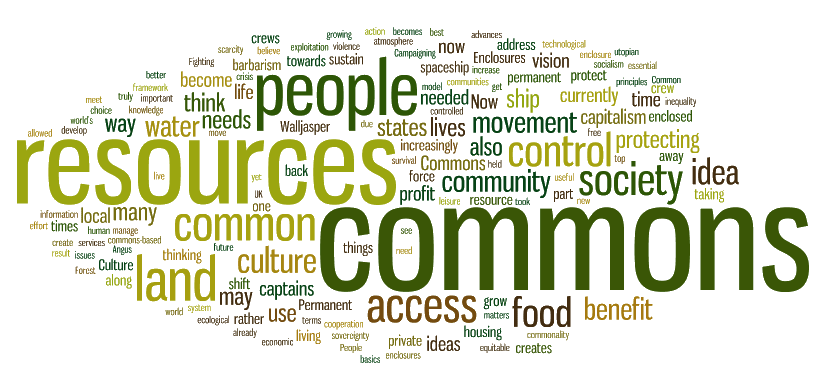
The Question of the 'Tragedy of the Commons'
Via Aeon
By Michelle Nijhuis, Project editor at The Atlantic and author of Beloved Beasts: Fighting for Life in an Age of Extinction (2021)
May 2021
In December 1968, the ecologist and biologist Garrett Hardin had an essay published in the journal Science called ‘The Tragedy of the Commons’. His proposition was simple and unsparing: humans, when left to their own devices, compete with one another for resources until the resources run out. ‘Ruin is the destination toward which all men rush, each pursuing his own best interest,’ he wrote. ‘Freedom in a commons brings ruin to all.’ Hardin’s argument made intuitive sense, and provided a temptingly simple explanation for catastrophes of all kinds – traffic jams, dirty public toilets, species extinction. His essay, widely read and accepted, would become one of the most-cited scientific papers of all time.
Even before Hardin’s ‘The Tragedy of the Commons’ was published, however, the young political scientist Elinor Ostrom had proven him wrong....
Community-based conservation can’t solve everything, and it doesn’t always succeed in protecting the commons. In many cases, national governments don’t recognise the longstanding land claims of Indigenous and other rural communities, creating uncertainty that interferes with community efforts to manage for the long term. Even well-established systems are vulnerable to internal conflict, and to external pressures ranging from drought to war to global market forces. As Ostrom often reminds... any strategy can succeed or fail.
Community-based conservation is distinctive because many societies have only begun to understand – or remember – its potential. "What we have ignored is what citizens can do."

🌎



GreenPolicy360 Categories & Index
Snapshot, Top Pages


GreenPolicy360 journeys across 50+ years of the modern environmental movement
'Earthrise' to 'Earth Day' & On & On to Today
* https://www.greenpolicy360.net/w/Earth_Day_Memories_on_the_50th_Anniversary
Connecting & sharing world changing stories
Community-to-Community
Green Networking, Green Best Practices
Earth in Human Hands

Together, We Are on 'Spaceship Earth'

'Spaceship Earth?'
At the Beginning, an Image of 'Earthrise', 1968-69, a New Vision Presented

Going Green: A Half-Century of 'Living Earth' Awareness
- ··················································································
"PlanetCitizen" | Planet Citizens | Planet Citizen Action
Community-based conservation is distinctive because many societies have only begun to understand – or remember – its potential.
- "What we have ignored is what citizens can do."
Driven in the Short-term and/or Acting for the Common, Long-term Good
Envisioning "The Commons"
- Out-in-Front Politics
New Definitions of National Security
🌎
Environmental Protection -- Local, National, Regional & Global
Environment & Security: New Security Policies Beyond Nation States


Global Climate Summits in Paris (2015), Glasgow (2021) and Sharm El-Sheikh (2022): Now the National Promises and Pledges Need To Be 'Reality Checked'
- ·············································································
- The Global Internet and the Digital Commons

GreenPolicy360, hosted on the open/public MediaWiki platform
Differences between Wikipedia, Wikimedia, MediaWiki, and wiki
Why did Wikipedia succeed?
The Beginning of Wikipedia, 2000, in St. Petersburg, Florida
- Wikipedia
- Jimmy Wales / Founder - https://en.wikipedia.org/wiki/Jimmy_Wales

····································································
Common Ground Values in Action
Economics as "Eco-nomics"
Environmental full-cost accounting
·········································
Reclaiming the Commons
The silent theft of our shared assets and civic inheritance need not continue
By David Bollier / Boston Review / Economics After Neoliberalism
• http://bostonreview.net/forum/david-bollier-reclaiming-commons
GreenPolicy360 Siterunner: This is an extended, thoughtful reflection on 'the Commons' and 'Commonwealth'. Well worth reading and sharing...
One of the great questions of contemporary American political economy is, who shall control the commons? "The commons" refers to that vast range of resources that the American people collectively own, but which are rapidly being enclosed: privatized, traded in the market, and abused...
One of the great questions of contemporary American political economy is, who shall control the commons? "The commons" refers to that vast range of resources that the American people collectively own, but which are rapidly being enclosed: privatized, traded in the market, and abused...
Varieties of Commons
The American commons comprises a wide range of shared assets and forms of community governance. Some are tangible, while others are more abstract, political, and cultural. The tangible assets of the commons include the vast quantities of oil, minerals, timber, grasslands, and other natural resources on public lands, as well as the broadcast airwaves and such public facilities as parks, stadiums, and civic institutions. The government is the trustee and steward of such resources, but "the people" are the real owners.
The commons also consists of intangible assets that are not as readily identified as belonging to the public. Such commons include the creative works and public knowledge not privatized under copyright law. This large expanse of cultural resources is sometimes known as the public domain or—as electronic networking increases its scope and intensity—"the information commons." In addition, our society has dozens of "cultural spaces" provided by communications media, public education, and nonprofit institutions. Another large realm of intangible assets consists of scientific and academic research, much of which is supported by the public through government funding. The character of these spaces changes dramatically when they are governed as markets rather than as commons.
No less important and vulnerable are what might be termed the "frontier commons": features of the natural world that have historically been too large, too small, or too elusive for any market regime to capture and that have often been regarded as parts of a common human heritage. Yet entrepreneurs and corporations are now developing ingenious ways to turn these natural commons into exploitable property. Several multinational companies are, for example, seeking to transport huge supplies of freshwater in Northern countries to "thirsty" regions in Saudi Arabia, Morocco, and southern California. Biotech companies are trying to gain proprietary control over agricultural seed-lines that have long been regarded as community assets—for example, by seeking patents for a common yellow bean grown widely in Mexico, as well as for basmati rice and neem plants in India. The human genome is a target of property claims and landowners fighting environmental regulations insist that they "own" wildlife and that the regulations amount to an unconstitutional "taking" by government.
A last category of threatened commons is that of so-called "gift economies." These are communities of shared values in which participants freely contribute time, energy, or property and over time receive benefits from membership in the community. The global corps of GNU/Linux software programmers is a prime example: enthusiasts volunteer their talents and in return receive useful rewards and group esteem For the most part, no money changes hands, yet economically valuable work occurs. Gift economies are the animating force behind scientific research communities, blood donation systems, New York City's community gardens, and Alcoholics Anonymous.
What unites these highly disparate commons—from natural resources to public domain to gift economies—is their legal and moral ownership by the American people. The commons comprises not just marketable assets, but social institutions and cultural traditions that help define our common life as Americans. In virtually every case, the market price for a resource does not begin to capture its actual value to the larger community. But generally we have no rigorous way to speak about such shared assets, or about the costs of enclosing them.
Learning to see the Commons
In an age of market triumphalism and economic myopia, it is an open question whether the notion of "commonwealth"—that we are a people with shared history, common values, and control over collectively owned assets—has practical meaning. As private interests have quietly seized the American commons, we have lost sight of our heritage as a democratic commonwealth. A society in which every human transaction is increasingly mediated by the market, in which everything is privately owned and controlled, may come to resemble a network of medieval fiefdoms, in which every minor property-holder demands tribute for the right to cross his land or ford his streams. This balkanization is bound to impede the flow of commerce and ideas—and the sustainability of innovation and democratic culture...
······························
At its core, climate change is a 'Tragedy of the Commons'. First coined by Garrett Hardin in 1968, based on an 1833 publication by William Forster Lloyd, this concept dates back to the time when villages shared a common grazing area. Each individual villager would benefit from grazing as many animals as they could on the commons. If everyone did that, though, the land would become dry and barren and no one would be able to graze. As individuals, villagers lacked the incentive to limit their own behavior for the common good. Only by acting together was it possible to preserve this shared resource.
In the same way, our planet is now our global commons. Whenever we dig coal, oil, or natural gas out of the ground and burn it, we release that carbon into the atmosphere—carbon that would not naturally reach the atmosphere for millions of years.
Climate, Politics and Religion / Professor K. Hayhoe / Texas Tech / 'My opinion' - 2015
·············································································
- Earth 'Stewardship': Religion, Community, and Values
- ○ ○ ○ ○ ○ ○ ○

- ○ ○ ○ ○ ○ ○ ○ ○ ○ ○
Environmental Protection, Global & Indivisible

○ ○ ○ ○ ○ ○ ○ ○ ○ ○
An Earth Point of View
································································
GreenPolicy360: We began our personal story in The Modern Environmental Movement in the mid 1960s. A meeting with our local US Congress Representative set in motion a decades-long journey.
Visit GreenPolicy360's up close 30+ year collaboration with this Congressman, George E. Brown. George came to be known in Congress over these years as "Mr. Science" and he literally envisioned and had oversight of a first-generation of foundational Earth science missions and programs of the US.
From the first national Climate Act and on and on... Read about George here:
GreenPolicy360 Siterunner: The beginnings of modern environmental and climate science can be traced to the 1960s and 1970s. The U.S. National Academy of Sciences played a key role in laying a foundation of scientific reports and data.
Memories of the first Climate Act legislation (Drafted by Rep. George E. Brown) 1978
Advancing Science, Facts, Technology and Data to Make the Case for Environmental Protection
- Planet Citizen Eco-Action, Big Science, and a New Vision
In Memory of Congressman George Brown
- Visionary Leadership, Historic Environmental Achievements
- Creating a Foundation for Today's National & Global 'Green' Movement

We coined the term 'Thin Blue Layer' many years ago. We vividly remember when the first full-color images of our planet were returned from NASA missions, published in national magazines like "Life" and then distributed widely. There, surrounding the Earth, was a narrow ring around Earth, our planet's 'atmosphere'. Science called it a Troposphere and we realized that this very thin atmosphere was enabling all life on Earth as we know it.
The atmosphere is an integral element of The Commons. As Planet Citizens, we have a shared responsibility not to ignore its role in protecting life.


ThinBlueLayer.com
- ·······································································································
Steve Schmidt, GreenPolicy360 Siterunner:
Congressman Brown became a pioneering Planet Citizen, in my opinion, as he advanced science-sharing in what is now called an open access protocol. He believed, and as a chair and leader on the Science, Space and Technology Committee, with its central role, that the data of Earth science should be share and made available for the greater good of humankind. He was the force behind the Landsat program, for example, and overcoming opposition, he brought the Landsat images of the world's landscapes to scientists everywhere. The data results of the Earth science missions, from Landsat to multiple missions with many universities and tech partners like JPL were responsible for mapping and measuring, creating digital and laser imaging in the process and ongoing databases with dynamic recording that could now, for the first time, monitor land/water/air/soil/aquifer and more systems changing over time. This brought new ways of seeing and understanding as George's vision led to fleets of satellites studying Earth systems brought data for intelligent policy decisions.
There are many types of Planet Citizens who act to make a positive difference every day in their communities and their work. Let me another who opened eyes to a new way of a seeing and a new world of understanding.
During the 1970s and 80s another scientist man of action I worked alongside also deserves to be remembered. His name, Don Perry.

As George Brown was engaged 'up above' in studying and discovering the atmosphere and how it and Earth systems were changing due to human industrialization, Don Perry was also 'up above' and looking closely at CO2 and life of and among the forests with their role in Earth's atmospheric systems.
Note: Re: the role of forests in atmospheric systems impacting climate change,
take time to consider how an AI app describes the importance of forests:
>Forests act as carbon sinks by absorbing more carbon dioxide from the atmosphere than they release, helping to mitigate climate change. They sequester approximately 16 billion metric tonnes of CO2 annually, making their preservation crucial for maintaining this vital climate service.
With this thought in mind, let's look closer at Don and our work that joined the science of George Brown to that of Don Perry.
Accompany a bio-pioneer ('bioneer') of science, Donald Perry, up above and swinging in a 'canopy web'...
Learn of inventing 'zip-lines', a 'tram for science observations', new ways of doing biology in the richest biosphere that was not yet seen and just beginning to be valued. The role of forests and climate was in its earliest phases. A living and an essential environment needed to be protected was being brought into the light...
GreenPolicy360's Siterunner writes about the 'Jacques Cousteau of the Rainforest' -- Don Perry. We arranged publication worldwide. Don was revealing forest life as it had never before been seen... This was an eco-story, a forests story that carried a vital message.
Life Above the Jungle Floor
by Don Perry

Published in 1986
🌳


~
Onward
For over fifty years, since the mid-1960s, work for environmental protection in defense of The Commons has carried on, sometimes successfully, often hopeful, and too often frustrated by the difficulties in building a green quality of life, with new definition of security and sustainable eco-nomics' .
Today, as global challenges confront us all, challenges now recognized as existential with present and imminent dangers to The Commons, we know we must carry on...
After all, we have been at this quest for many years and we are young and energetic!

- DYK? Yes, we do, we remember the beginnings !


On the 50th Anniversary
Memories on the Road to the First Earth Day
• https://www.greenpolicy360.net/w/Earth_Day_Memories_on_the_50th_Anniversary
* https://www.greenpolicy360.net/w/Category:Earth_Day
······························
Earth Day Is Every Day ...
* https://strategicdemands.com/
GreenPolicy360 & Strategic Demands: 'We Intend to Protect the Common Good'
Environmental Security & "Thin Blue"
Strategic Demands: New Definitions of National Security and Environmental Security
○
- Air Quality
- Alternative Agriculture
- Aquifers
- Anthropocene
- Atmosphere
- Atmospheric Science
- City Governments
- City-County Governments
- Clean Water
- Climate Change
- Climate Policy
- Democracy
- Earth
- Earth System Science
- Eco-nomics
- Ecological Economics
- Ecology Studies
- Economic Development
- Economic Justice
- Economics
- Environmental Protection
- Environmental Security
- Externalities
- EOS eco Operating System
- Food
- Forests
- Global Security
- Global Warming
- Green Best Practices
- Green Banking
- Green Business
- Green Infrastructure
- Green Politics
- Green Values
- Health
- Initiatives
- Labor Unions
- Natural Resources
- Natural Resource Economics
- New Definitions of National Security
- Networking
- New Economy
- Ocean Ecosystem
- Ocean Science
- Ocean Sustainability
- Oceans
- Permaculture
- Planet Citizen
- Planet Citizens
- Planet Scientist
- Planet Citizens, Planet Scientists
- Resilience
- Rights of Nature
- Sea-level Rise
- Sharing Economy
- Social Justice
- Strategic Demands
- Sustainability Policies
- ThinBlueLayer
- Toxics and Pollution
- United Nations
- US Environmental Protection Agency
- Digital Citizen
- Digital Rights
- Education
- Human Rights
- Internet
- Mobile Internet
- Online Education
- Online Privacy
- Planet API
- World Wide Web